Talking about the advantages, disadvantages and development prospects of wireless chargers

Talking about the advantages, disadvantages and development prospects of wireless chargers
As a major innovation in modern technology, wireless chargers have won the favor of the market for their convenience and practicality. When discussing the advantages and disadvantages of wireless chargers and their development prospects, we must recognize the series of changes they bring.

On the one hand, wireless chargers lead the innovation of charging methods with their unique advantages. They eliminate the need for cables, making the charging process more simple and beautiful. Users don’t need to worry about cable entanglement or damage, and at the same time, the use of wireless chargers also reduces the occurrence of poor contact, short circuits, and other problems. In addition, the popularity of wireless chargers in some public places, such as cafes and shopping malls, provides great convenience for consumers.
However, wireless chargers also have shortcomings. In terms of charging efficiency, compared with wired charging, wireless charging is relatively slow, which may be less satisfactory for users who pursue speed. In addition, wireless chargers may generate a certain amount of heat during the charging process due to the energy conversion efficiency, which may have a certain impact on the charging device.
In terms of development prospects, wireless charging technology is progressing. In the future, as wireless charging technology matures, the charging efficiency will be significantly improved and the charging range will be further expanded. It is foreseeable that wireless chargers will gradually become the standard configuration of electronic products such as smartphones and wearable devices, and may even realize the wireless charging of electric vehicles.
In this process, the wireless charger will promote the development of China’s new energy industry, promote the popularization of the concept of green environmental protection, and bring more convenience and possibilities to people’s lives. With the continuous progress of science and technology, we have reason to believe that the wireless charger will play a more important role in the future.
With the rapid development of science and technology today, wireless chargers as a new charging technology, are increasingly penetrating our daily lives. It not only provides a more convenient charging method but also plays an indispensable role in the modern technological environment. The purpose of this paper is to explore the concept of wireless chargers in depth, analyze its advantages and disadvantages in practical applications, and look forward to its future development prospects, to provide readers with a comprehensive and profound understanding of this emerging technology. Exploring this topic not only helps us to understand the important role of wireless chargers in modern life but also has important practical significance and guiding value, providing a reference for us to better apply and develop this technology in the future.
Wireless chargers, as a product of the development of modern technology, its working principle and variety is amazing. The basic working principle of a wireless charger, based on electromagnetic induction or magnetic resonance technology, realizes wireless transmission of energy by transmitting and receiving electromagnetic waves. Specifically, it consists of a transmitting end and a receiving end. When the transmitting end produces a changing magnetic field, the receiving end generates a corresponding current, thus charging the device.
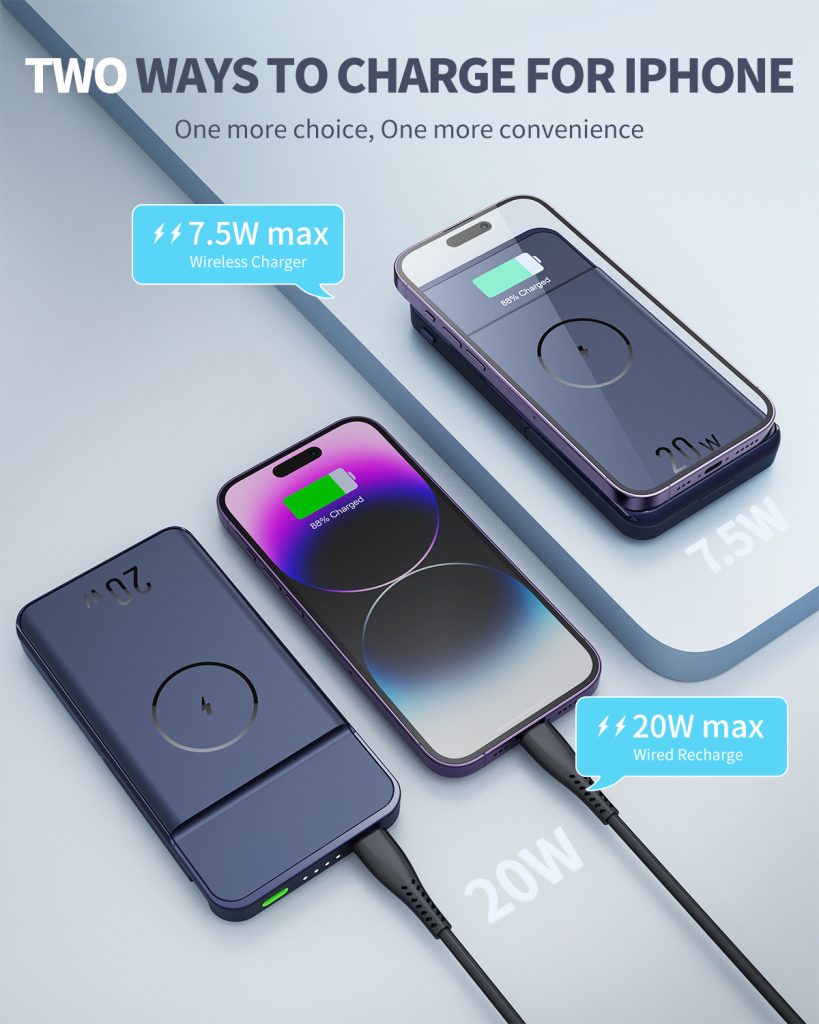
In terms of the types of wireless chargers, there are mainly the following on the market: inductive wireless charging, magnetic resonance wireless charging, RF wireless charging, and laser wireless charging. Inductive wireless chargers are the most common and represent the Qi (pronounced “chee”) standard, which was developed by the Wireless Power Consortium (WPC) to provide a unified, compatible wireless charging solution for a wide range of electronic devices.
There are many different types of wireless chargers with other technical standards, but together they form the cornerstone of wireless charging technology. With the development of technology, the advantages and disadvantages of wireless chargers have gradually emerged. In terms of advantages, wireless chargers are free from the shackles of wires, making the charging process more convenient; at the same time, since wireless chargers do not have physical interfaces, they can also reduce the risk of equipment damage to a certain extent. However, the shortcomings of wireless chargers should not be ignored, such as charging efficiency is relatively low, and charging distance being limited.
Looking ahead, wireless chargers are expected to play an important role in several fields. With continuous technological innovation and breakthroughs, the performance of wireless chargers will continue to improve, and the charging distance and efficiency will be significantly improved. In the future, wireless charging technology is expected to become the standard in smart homes, smart cities and other fields, further changing people’s lifestyles.
When exploring the many features of wireless chargers, their convenience is undoubtedly one of the most compelling features. Wireless chargers eliminate the hassle of cable connections, making the charging process incredibly simplified. Imagine not having to worry about finding the right charging cable and connector in the busy pace of life, but simply placing your device lightly on the charger and it will start charging instantly. This freedom of charging as you go is undoubtedly one of the great conveniences of modern life.

At the same time, the safety of wireless chargers has also received widespread attention. Compared with traditional chargers, wireless chargers do not have exposed connectors, which greatly reduces the risk of leakage and short-circuit, providing users with a more secure experience.
Intelligence is another highlight of wireless chargers. The wireless charger automatically recognizes the energy demand of the device and intelligently adjusts the output power to ensure efficient and stable charging of the device. More importantly, when the device is fully charged, the wireless charger will automatically turn off the output, which not only protects the battery, but also saves energy, reflecting the respect of modern technology for the concept of environmental protection.
Against this background, the development prospects of wireless chargers seem particularly bright. With the continuous progress of technology, the future wireless charger will be more intelligent and efficient, not only to meet the changing needs of personal electronic devices but also may be expanded to electric vehicles and other large-scale equipment, contributing to the green mobility of mankind.
When discussing the experience of wireless chargers, we have to mention a few of its obvious shortcomings. The relatively low charging efficiency of wireless chargers is particularly noticeable, and it often cannot match the speed of wired charging. Due to the limitations of the technical principle, wireless charging usually means longer charging times, which certainly causes some inconvenience to users who are in a hurry to use their devices.
At the same time, the limited distance of wireless charging is also a problem that cannot be ignored. For a device to charge successfully, users need to ensure that the charger is in close contact with the device or remains within a specific effective range. This restricts the user’s freedom to move around within a certain distance, as is the case with wired charging.
Cost-wise, wireless chargers are also more expensive to manufacture than wired chargers, which directly contributes to the generally higher price of wireless chargers. Although the cost is expected to decrease gradually with the advancement of technology, at present, this disadvantage makes the popularization of wireless chargers somewhat constrained.
Despite these shortcomings, the development prospect of wireless chargers is still worth looking forward to. With the development and innovation of technology, its efficiency, charging distance, and cost are expected to be improved, thus bringing users a more convenient and efficient experience.
When discussing the development prospects of wireless chargers, technological advances have undoubtedly become a key factor in driving the improvement of charging efficiency. The development of new technologies, such as RF charging and laser charging, is gradually breaking the limitations of traditional wired charging, bringing users a more convenient charging experience. At the same time, the development of compatibility and standardization is also advancing, and the widespread application of mainstream wireless charging standards such as Qi and AirFuel in the fields of smartphones, wearable devices, and household appliances has made wireless charging technology gradually become the industry’s new favorite.
The growth of market demand should not be ignored. The popularization of smartphones, wearable devices, and other electronic products has led to a growing demand for wireless chargers. In addition, the support of government policies and the prediction of market trends also provide a strong guarantee for the development of the wireless charging industry. Policy-level support, such as subsidies and tax incentives, will help promote the popularization and application of wireless charging technology. And the future market trends and scale forecasts reveal that wireless chargers will play a more important role in the field of electronic products and bring more convenience to human life.
When discussing the performance and potential of wireless chargers in depth, it is not difficult to find the many advantages and limitations it contain that cannot be ignored. Wireless chargers have greatly enriched users’ daily lives in modern society with their convenience and modernized charging methods. However, the problems of efficiency, compatibility, and cost cannot be ignored. Looking ahead, wireless chargers have a bright future but also face the dual challenges of technological breakthroughs and market competition.
Sorting out the advantages and disadvantages of wireless chargers, we can see that their convenience and safety bring users a new charging experience, but the relatively limited charging efficiency and high cost, as well as compatibility issues, have become a bottleneck that restricts their wide application.
On the road to the future, wireless chargers are expected to realize more efficient charging, expand the application range, and reduce costs through technological innovation. At the same time, competition and cooperation within and outside the industry will also promote the continuous progress of wireless charging technology. In this regard, I would like to put forward the following suggestions and prospects for the wireless charger industry: increase R&D investment to improve the charging efficiency and stability of wireless chargers; optimize product design and enhance compatibility to meet the needs of different devices; and at the same time, explore the integration with new energy, the Internet of Things and other fields to open up more application scenarios for wireless chargers, and to promote the sustainable development of the industry.
Shenzhen DHongtai Electronic Technology Co., Ltd. was established in 2012. It is a professional company integrating , technology, management, manufacturing, and sales. We have modern workshops, advanced equipment, and a group of high-quality professionals to provide systematic and high-quality HD equipment connection solutions for global customers. We have unique advantages in OEM/ODM.Official website Address:https://www.dht-link.com/
