
When purchasing wireless chargers, consumers need to pay attention to a number of aspects to ensure that they buy safe, reliable and practical products. Here are some key shopping considerations:
First, clear charging requirements
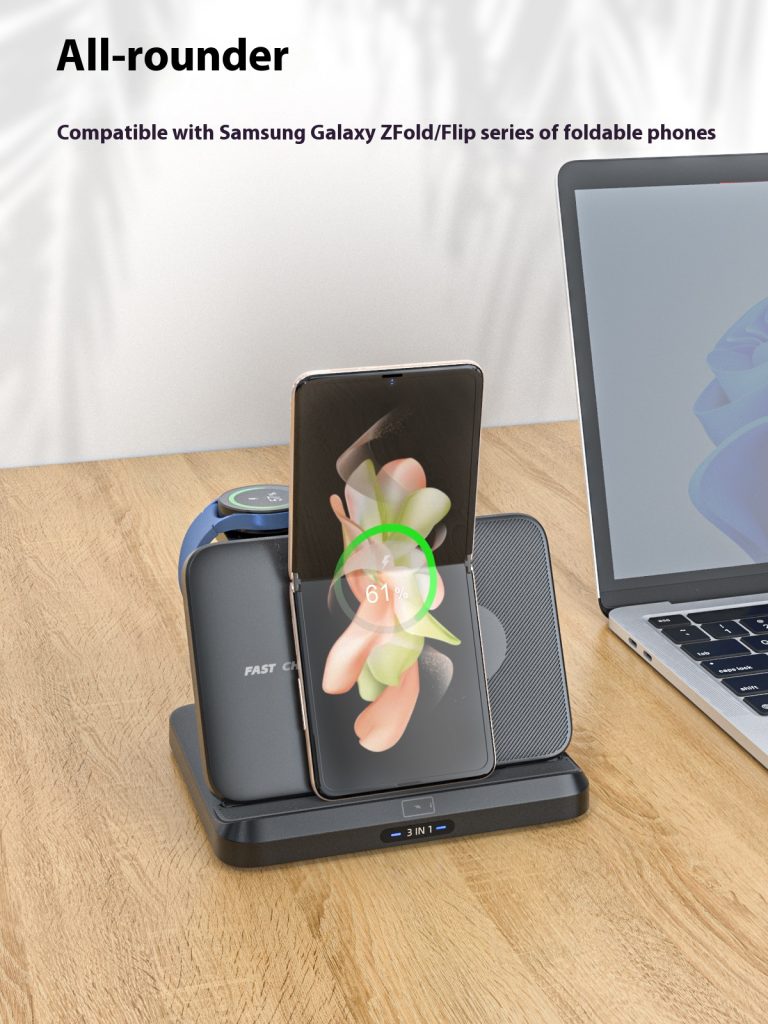
Device compatibility: Verify that the wireless charger is compatible with your phone or other device. Check the wireless charger’s specifications and compatibility list to make sure your device works with the charger.
Application scenario: Select the appropriate wireless charger type based on the application scenario. For example, a desktop wireless charger can be selected for desktop use, a portable wireless charger can be selected for going out, and a car-mounted wireless charger can be selected for car use.
Second, pay attention to product power
Power selection: The power of the wireless charger is an important parameter. It is recommended to select a wireless charger with appropriate power according to your charging device. If you need fast charging, you can choose a high-power wireless charger; If the device itself charges quickly, a low-power wireless charger may be more appropriate.
Third, check the appearance and logo
Appearance quality: Check the appearance quality and material of the wireless charger, the appearance should be free of burrs and seams without defects. Metal contacts should be thick and uniform. Vertical wireless charging is better than flat type heat dissipation, metal heat dissipation is better than plastic.
Identification integrity: Pay attention to the packaging and body of the wireless charger, and confirm that there is a logo and clear and complete, such as product name, model specification, trademark, manufacturer, manufacturing date or batch number, implementation standard number, etc. At the same time, there should be detailed input and output parameters and other information.
Fourth, understand the implementation standards
Implementation standards: Confirm whether the wireless charger product explicitly implements standards. It is recommended to purchase the identification of GB/T37687-2019 “General Specification for Low power Wireless Chargers for Information technology electronic information products”, GB4943.1-2011 “Information technology Equipment Safety Part 1: General Requirements”, GB/T37132-2018 “General Requirements and test methods for Electromagnetic compatibility of wireless charging equipment”, GB /T9254-2008 “Information technology equipment radio disturbance limits and measurement methods” and other national standard products.
Fifth, pay attention to the use of safety
Avoid placing redundant items: Wireless charging uses the principle of magnetic induction to charge electronic devices, and do not place any items between the electronic device and the charger during the charging process, especially magnetic brackets, magnetic protective covers or other objects, which may reduce the performance of the charger or damage the magnetic strip, RFID chip, etc.
Make sure the coils are aligned: If the charging device vibrates (such as when notified), it may shift, causing the wireless charger to stop providing power to the device. Consider turning off the vibration function, turning on Do not disturb mode, or using a protective housing to prevent movement and ensure that the coils are aligned.
Stay away from high temperatures: Do not expose wireless chargers to high temperatures or around heating devices, such as sunlight, heaters, microwaves, ovens, or water heaters.
Do not play while charging: It is recommended not to play with your phone while charging, as running CPU-intensive applications on a charged device may cause it to heat up quickly. If you must use the device while charging, try to avoid using games or other power-intensive applications.
Power safety: Do not use uncertified or incompatible power supplies, chargers, or batteries to power your wireless charger. Avoid charging for a long time. It is recommended to unplug the power cord of the wireless charger when it is not in use to reduce safety risks.
Sixth, consider brand and price
Brand choice: Choose a wireless charger brand that is certified and has a good reputation to ensure the safety and stability of the charging process.
Price factor: Different brands and quality of wireless chargers vary in price. Choose the right wireless charger for your budget.
To sum up, the purchase of wireless chargers needs to be considered from many aspects to ensure that the purchase of products that meet their needs. At the same time, you should also pay attention to safe use when using wireless chargers to avoid accidents.
Shenzhen DHongtai Electronic Technology Co., Ltd. was established in 2012. It is a professional company integrating , technology, management, manufacturing, and sales. We have modern workshops, advanced equipment, and a group of high-quality professionals to provide systematic and high-quality HD equipment connection solutions for global customers. We have unique advantages in OEM/ODM.Official website Address:https://www.dht-link.com/
